
Global Coworking Space Market
Coworking spaces are communal offices from where entrepreneurs, remote workers and freelancers can operate independently while enjoying the benefits of a collaborative setting. They offer a range of facilities such as printers, conference rooms, lounges and others.
Successful coworking spaces offer a conveniently located workspace that fosters a sense of community. At first, joining isn’t necessarily about becoming a permanent member – many users are independent freelancers who value autonomy but want to escape the isolation of working alone. They’re drawn by the opportunity to connect with others and enjoy social interaction. However, to retain members long-term, the space must also demonstrate added value through meaningful benefits like building professional networks, sparking collaborative projects, and creating a supportive environment.
The concept of a coworking space involves:
- Offering different workstations that can range from desks and private offices to meeting rooms and open spaces.
- Providing flexible membership plans allowing renters to move in and out and upgrade or downgrade with short notice periods.
- Designing workshops, seminars and other social events to create a strong business network among its members.
The concept of a coworking space first appeared in 1995 in Berlin, Germany, and at that time it was called a “hackerspace”. It was created by 17 computer engineers with the aim of establishing a non-profit place where computer enthusiasts could come together and work on their projects while also having the opportunity to socialize.
In 2002, two Austrian entrepreneurs opened the first coworking space called Schraubenfabrik in an old factory in Vienna where architects, PR consultants, startups and freelancers could collaborate. Gradually, more and more coworking space appeared all around the world and in 2020, there were around 19,500 coworking spaces globally and their number is expected to reach 41,975 coworking spaces by the end of 2024 according to Statista. In the 2020 Global Coworking Growth Study by CoworkingResources, it was predicted that in 2024, 5 million people will be using coworking spaces.
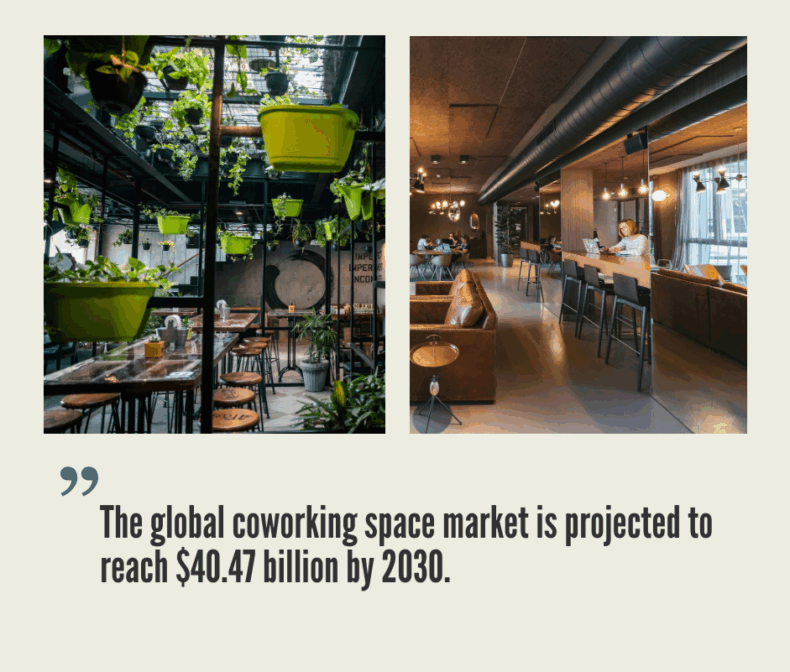
The coworking space market size was estimated at $14.91 billion in 2023 and is projected to grow at a compound annual growth rate of 15.7% from 2024 to 2030 to reach $40.47 billion by 2030, according to Grand View Research. This growth is expected to be driven by the rise of remote work, increase in startups, and businesses searching to reduce costs by avoiding traditional office rentals.
In addition to remote workers, businesses are also planning to increase their use of coworking spaces. The 2025 Global Occupancy Planning Benchmark Report from JLL reveals that by 2030 it is expected that 30% of all office space will be flexible.
A 2023-2024 Global Workplace & Occupancy Insights report highlighted that in the next three years, 43% of organizations from their survey plan to “increase space-sharing and eliminate underutilized space”, consequently creating demand for coworking spaces which can become the new offices for the workers of these companies. This decision is the result of more and more businesses discovering that switching to flexible office spaces reduces their operating costs by 20-30% through the conversion of fixed costs such as rent to variable costs. An analysis by Workways found that in France for instance, a business can cut its office operation costs by 25% through choosing flexible office space usage. Gensler’s Global Workplace Survey Comparison 2023 reveals that “average office occupancy rates” are around 46.3% which suggests that workers are gravitating more and more towards working outside the office.
Coworking Space Market by Region
North America
North America held the largest share of the coworking space market in 2023 (34.6%) with the U.S. accounting for 68% of the region’s revenue.
According to WFH’s recent data from SWAA (U.S. Survey of Working Arrangements and Attitudes), in Spring 2025, 13% of full-time employees were working remotely while 27% were in a hybrid arrangement. The coworking space market size in the United States was estimated at $5.11 billion in 2024 by Mordor Intelligence and is predicted to reach $8.58 billion by 2029, the top markets being Los Angeles and Manhattan.
In the second quarter of 2025, there were 7,840 coworking spaces in the U.S., covering 141.29 million square feet with the largest number of coworking spaces found in Los Angeles (3.8% of the national total), Chicago and Washington, D.C. (both 3.6%).
Europe
Europe – the second largest coworking space market in the world – was valued at $3.91 billion in 2023, projected to grow at a CAGR of 17.8% to reach $12.3 billion by 2030. In 2025, there were around 6,850 coworking spaces in Europe with their total area accounting for 2.5% of the total office area in the region. Coworking spaces have been growing every year by 4.7%, driven by increasing adoption of hybrid working and demand from startups. Cities with the largest number of spaces were London (over 1,400), Paris (around 750), and Barcelona (around 400). Usage levels are also high with an 82% occupancy rate in London, 78% in Stockholm and 78-81% in Barcelona.
The UK is the largest coworking space market in Europe with 2,800 spaces (41% of the region’s total) with 10.1% located in London. London experiences particular popularity with coworking spaces as an estimated 10% of its office space is flexible. In Southern Europe, Spain’s coworking spaces are growing rapidly with Barcelona alone having over 2,300 new coworking desks in the first half of 2024. Portugal also enjoys high occupancy rates due to its popularity with digital nomads.
Asia Pacific
Between 2015 and 2019, the flexible office space market in Asia Pacific grew at an annualized rate of 51%. In recent years, the growth rate slowed down to 4% and in the first half of 2024, flexible office space accounted for around 4% of total office space in the region. Despite the slowing growth, strong demand for coworking spaces still remained. From 2019 to 2024, demand for flexible workspaces in the Asia Pacific region rose by 13% with some cities such as Auckland (New Zealand) and Seoul (South Korea) growing at a CAGR of 22% and 20%, respectively.
Out of all the regions, over the next few years the coworking space market is expected to grow at the fastest CAGR of 21% in the Asia Pacific. Valued at $3.09 billion in 2023, it is expected to reach the value of $11.82 billion by 2030. In addition to the region’s popularity with digital nomads, in large cities, demand is also likely to come from medium to large businesses seeking to cut costs – according to data from Knight Frank, their 2023 survey found that of organizations in the Asia Pacific region with more than 50,000 workers, 45% say they are likely to increase their use of flexible and coworking spaces.
Among the countries in the region, India in particular is experiencing great growth, fueled by the rise of the gig economy (increasing number of freelancers and startups) and a shift toward remote work, with estimates of a coworking space market size of $1.94 billion in 2024. By 2029, the market’s value is expected to reach $2.72 billion.
Latin America
From 2010 to 2020, the number of coworking spaces surged by 230% in Latin America, and in 2022, Instant Group estimated that there were around 525,000 flexible office spaces with a total area of 1.68 million sq. m, the largest markets being Brazil, Chile, Colombia, Mexico, and Peru. The highest concentration of coworking spaces were in Sao Paulo, accounting for 15% of the total number in the region, followed by Mexico City which accounted for 13%. Market Report Analytics estimated in 2025 that Brazil holds a 30% share of the Latin American coworking space market, followed by Mexico with 25%. Mordor Intelligence estimates the Latin American coworking space market in 2025 at $1.84 billion and projects that it will grow at a CAGR of 10.64% to reach $3.04 billion by 2030.
Demand for flexible office space in Latin America increased by 29% from 2022 to 2023 with an especially dramatic rise of 163% in Mexico City. The region’s growing popularity of coworking spaces is likely attributed to its relatively affordable cost of living (around 25% lower than the average in the U.S.) that attracts digital nomads and the increasing acceptance of the hybrid work model.
Who uses coworking spaces?
Small and Medium Businesses (SMEs)
SMEs hold a 38% share of the coworking space market – the largest share among all user segments. SMEs’ financial resources are more limited than those of large corporations and instead of being spent on rent of a traditional office, these funds can be better utilized in other areas of business. In addition to keeping costs low, coworking spaces can provide a more refreshing and casual atmosphere for SMEs’ workers, helping to boost their productivity.
Large Corporations
In 2025, an estimated 36% of coworking space users were large corporations – making them the second largest group of coworking space users, just behind SMEs – and they are projected to account for 40% of the growing demand for coworking spaces. Large organizations are increasingly seeking to lower their costs by renting desks or offices in coworking spaces for their staff instead of renting and maintaining their own offices.
Freelance professionals
Freelancers make up around 17% of coworking space users and from 2024 to 2030, are expected by some industry experts to be the fastest growing segment among coworking space users. Freelance professionals are attracted by the well-equipped facilities and the community feeling that coworking spaces offer. Since freelance professionals often have a flexible schedule with customers potentially located in different time zones, coworking spaces with 24/7 access to meeting rooms are ideal for them. They would also appreciate networking opportunities to build connections with potential collaborators.
Startups
With uncertain prospects of success, they are more hesitant to rent their own office and this makes coworking spaces the ideal base of operations. Moreover, instead of insisting that workers attend a fixed office location every day, staff can operate from coworking spaces in any location which means startups can hire talent from all around the world. A number of currently successful companies started their operations from a coworking space, examples being Uber and Spotify.
Remote and Hybrid workers
This group of coworking space users may choose to work remotely full-time or part-time, continuing to come into their office for a number of days during a working week. Coworking spaces offer them the facilities they need to work comfortably on the days they choose to work remotely, such as fast Wi-Fi and technology for online conferences as well as additional amenities that their office may not offer: for example, a gym or a swimming pool. For hybrid workers, a bonus point would be if the coworking space is situated near a business district where their office is located as this would facilitate the attendance of in-person meetings or dropping off documents when needed.
Digital Nomads
The number of digital nomads has grown rapidly in recent years – in 2025, it surpassed 50 million which is a 43% increase from 2023. This has been fueled by the emergence of special digital nomad visas, advancements in remote work arrangements, and the acceptance of the hybrid work model. Digital nomads can be split into three categories – freelancers (accounting for around 41% of all digital nomads), remote workers (34%), and entrepreneurs (25%).
Statistics reveal that 21% of digital nomads are currently using coworking spaces. However, the potential demand for coworking spaces from this group can be even greater with one survey finding that more than 60% of digital nomads are actively looking for a coworking space or plan to look in the future. Since digital nomads are travelers, they would likely choose a coworking space that is located near public transport so they can easily access it from their accommodation, as well as proximity to restaurants, gyms, and tourist attractions so they can make the most of their stay.
What can be included in a coworking space?
Basic aspects:
- High-speed internet
- Workstations – open desks, private offices etc.
- Conference rooms
- Printers, scanners and photocopiers
- Kitchen or a pantry
Advanced facilities:
- Video conferencing equipment
- Soundproof phone booths
- Lockers and storage spaces
- On-site IT support services
- On-site cafes and restaurants
- Gyms and fitness facilities
- Gardens
Types of coworking spaces
| Open coworking spaces | These spaces aim to provide a collaborative working environment for everyone – individuals and corporate workers from a variety of industries – and offer shared amenities. |
| Niche coworking spaces | They cater to a specific customer segment by offering tailored amenities for the target community. For example, a coworking space can be female-only, creatively orientated, industry-specific or with an accent on wellness by having a yoga studio. |
| Corporate coworking spaces | They are occupied by established businesses – usually large companies – who would like to rent a space with a more flexible and collaborative environment for their workers and teams but still wish to ensure privacy and confidentiality. |
Coworking Space Market Infographics