
Hemp is a multi-purpose crop, delivering fibers, shivs, seeds and pharmaceuticals.
The benefits associated with hemp are endless. A number of products, which are used by people every day can be created from hemp. These products include, but are not limited to the following:
- Paper products: Hemp can be used to make paper and it only takes a couple of months to grow. Hemp is environmentally friendly. It is naturally acid free and can be recycled up to 7 times (normal paper can be recycled up to 3 times). During the process of converting hemp into paper, millions of pounds of toxic pollution are not released into the air.
- Clothing: Hemp can be used to make clothing. One acre of hemp produces as much material as 2-3 acres of cotton.
- Building materials: Hemp can be turned into a variety of building materials (i.e. fiber board, carpet, stucco, cement blocks, insulations, and plastic). You can build a wall out of hemp that is rot free, pest free, mold free, fire resistant, and will last 500 years. You can also make biodegradable plastic out of hemp.
- Gasoline/Fuel: Hemp can be turned into fuel that can be used in your car today. This is done by pressing the hempseed and turning its oil into a biodiesel that is not only completely biodegradable, but also smells better and is cleaner for the air. You do not need to alter your vehicle to use it. Hemp, however, is not the best alternative for fuel because it takes a lot of hemp to make one gallon of gas.
- Nutrition: Hemp can be used as a supplement for nutrition. Hemp is high in protein, contains essential omega 3 & 6 fatty acids, potassium, and dietary fiber.
These days, at least 70 countries cultivate hemp for commercial or research purposes. The largest producers of hemp are currently China, France, Canada, USA and Chile. In 2023, hemp acreage in North America and the European Union countries totaled about 75,000 acres and 85,000 acres respectively, while China – the world’s largest hemp fiber and seed producer – planted more than 340,000 acres of hemp, which put global acreage at about 520,000 acres.
In December 2018, the Farm Bill was signed into law to make hemp legal for the first time in the United States since the 1930s. The bill removes hemp from the Controlled Substances Act. Overall hemp acreage reached 78,176 in 2018 recording a tripling of land under hemp from 25,713 in 2017. The latest USDA data shows there were 5,604 active licenses in 2023 to grow about 45,000 acres of hemp, with 27,680 acres were planted.
Canada on its own accounts for 11% of global hemp cultivation. Since hemp cultivation was legalized in Canada, production has been variable year to year but generally increasing – which some attribute to increased import demand in the United States. According to the most recent data from Statistics Canada, the seeded area of hemp was about 62,000 acres in 2021, 76,900 in 2022, 55,400 acres in 2023 and 36,500 acres in 2024.
In recent years the area dedicated to hemp cultivation has increased significantly in the EU from 20,540 hectares in 2015 to 33,020 hectares in 2022. In the same period, the production of hemp increased from 97,130 tones to 179,020 tones. France is the largest producer, accounting for more than 60% of EU production, followed by Germany (17%) and The Netherlands (5%).
China is Asia’s leading hemp grower, producing 60-70% of the world’s hemp. The country exports about 90% of its products to the US, Germany, UK, Netherlands and Japan and has begun growing hemp in three provinces for CBD extraction purposes.
Australia, New Zealand, Germany, the Netherlands, Paraguay, Uruguay, Chile and South Africa are also among countries with active industrial hemp markets. Other countries and territories with active hemp grower or consumer markets can be found on our Interactive Hemp Legalization World Map below, which is updated regularly.
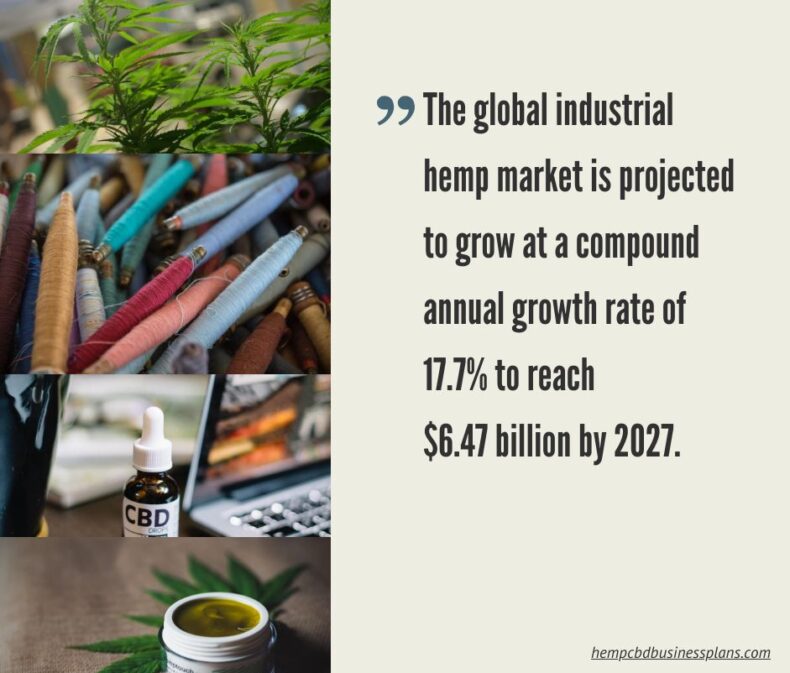
According to marketing analysis reports by Technavio, the global industrial hemp market size is set to reach $6.47 billion by 2026 with a CAGR of 17.7%. Data from Grand View Research reveals that the textile application segment dominated the industrial hemp market in 2023, followed by personal care and food and beverages.
Full Article: hempcbdbusinessplans.com.